Częstochowa from Kraków
Two hours north, Jasna Góra is Poland’s holiest place and a working shrine — the Black Madonna is unveiled at set hours with a fanfare, mass is usually in progress, and millions of pilgrims walk here every year. Visit as their guest.
The short version
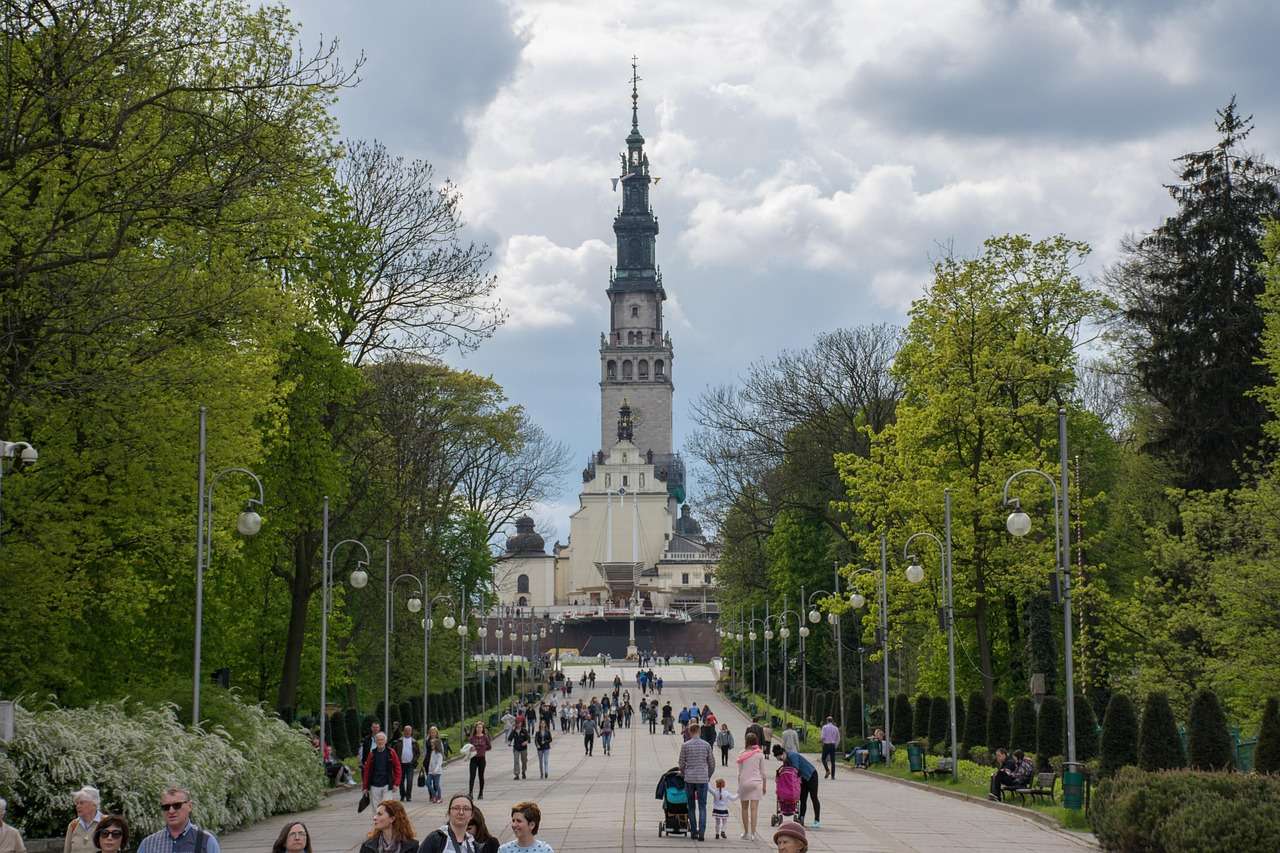
- Trains run Kraków to Częstochowa in roughly 2–2.5 hours (intercity.pl) — a committed but straightforward day — with the monastery a walk up the Avenue of the Holy Virgin Mary from the center or a short ride from the station.
- Jasna Góra is the Pauline monastery that has held the icon of Our Lady of Częstochowa — the Black Madonna — since 1382: Poland’s national shrine, drawing millions of pilgrims yearly, many arriving on foot in the great August walking pilgrimages.
- The unveiling rhythm per the alarm structures every visit: the icon is covered and revealed at set times daily with a trumpet fanfare, the chapel filling well before each; the day’s schedule (jasnagora.pl) is the one piece of planning that matters.
- The scars are the icon’s story told plainly: slashes cut across the Madonna’s cheek in a 1430 robbery have been preserved through every subsequent restoration — kept deliberately, per the alarm, as part of what the image is — and the faithful read them as the icon’s own wounds.
- The 1655 siege carries the national history: the monastery’s small garrison holding against Swedish forces during the Deluge became the turning legend of Polish identity, and the fortress ramparts you walk today are that history’s architecture.
- The complex beyond the chapel fills the respectful remainder: the basilica’s baroque nave, the treasury’s votive centuries (crowns, amber, soldiers’ medals left in thanks), the 600th-anniversary museum, and the tower climb — with the conduct register throughout: modest dress, chapel silence, photography restraint where signed, and mass given its space.

Getting there
The train times make this a full committed day per the glance — the schedule check at jasnagora.pl comes first, the train chosen to land an unveiling with margin. The Avenue approach on foot is the intended arrival: the long straight axis pilgrims have walked for centuries, the spire growing ahead. The register is the plan’s other half: this is a functioning monastery and Poland’s spiritual center, and the alarm’s guest framing — dress, silence, patience with crowds who came further than you — is the entire etiquette.
The visit
Arrive ahead of the unveiling and take a place in the Chapel of the Miraculous Image early — the room fills, the fanfare sounds, the cover rises, and whatever you brought to the moment, the collective intake of breath around you is the shrine explaining itself. The icon’s darkened Madonna and Child, the scarred cheek, the robes of beaten silver: viewed in stillness, at the pace the room sets. Afterward the complex opens out — the basilica’s nave, the treasury’s centuries of left things (the votive habit reading like the nation’s diary), the ramparts’ 1655 walk with the town below, and the tower for those with the legs. The museum layer tells the icon’s history, the sieges, and the pilgrimage tradition at documentary pace. Lunch runs simple along the Avenue. The return train closes a day that was never about the miles.
When to go
The shrine operates year-round with the unveiling rhythm constant. The great Marian feasts — August 15 and 26 especially — bring the walking pilgrimages to arrival: hundreds of thousands, the complex at full devotional voltage, and an experience of scale that is also the year’s least private visit; go then to witness it deliberately, or in ordinary weeks for the chapel at human density. Winter mornings give the quietest unveilings. Sunday masses fill everything regardless of season, which is not a complaint — it is the place working.
Frequently Asked Questions
What are the unveiling times?
The icon is revealed and covered at fixed points through the day — early morning through evening, with the schedule varying by season and feast — each accompanied by the trumpet fanfare. The monastery publishes the current schedule, and per the alarm, the day builds around one: arriving mid-cover means waiting, which the chapel makes easy and the rest of the complex makes useful.
Why is the Madonna black?
Centuries of candle soot, aged varnish, and the icon’s pigments darkened the faces — the image sits within a family of dark-toned Byzantine-tradition icons venerated across Europe. Tradition attributes the painting to St. Luke; scholarship reads a medieval icon with older layers. The shrine presents both registers, and the darkness long ago became the identity.
What exactly happened in 1430?
Robbers broke into the chapel, stripped the icon’s ornaments, slashed the Madonna’s cheek, and broke the panel. The restoration at royal command repaired the structure but preserved the slashes — recut into the new paint layers deliberately — and every restoration since has kept them. The scars are treated not as damage but as testimony, per the alarm’s phrasing.
Can non-Catholics visit comfortably?
Fully — as guests, which is the alarm’s framing for everyone: modest dress, silence in the chapel, movement around (never through) services, photography where permitted. No ticket, no gate; the shrine is free and open. Visitors of any belief who give the unveiling its stillness report it among the most affecting hours in Poland.
How does this fit a Kraków itinerary?
As its own day — the train times close the door on pairings, and the register warrants the space anyway. Kraków’s other documented days (Wieliczka, Zakopane on this network) are different worlds; Auschwitz remains its own day entirely per this network’s standing rule. Częstochowa is the devotional day: plan it around an unveiling and let the trains bracket it.