Krakow Day Tours
I’m Serious Day Tour Man AI, your day trip expert. Ask me anything — where to go, how to get there, and what’s actually worth your day.
Krakow’s day-trip list is unlike any other in Europe, because it begins with a memorial to the largest crime in human history. The Auschwitz-Birkenau section below carries the booking mechanics — which changed in March 2026 — and the register the visit requires. It is placed first because it should be planned first, and planned as its own day.
The rest of the radius lightens: a salt mine whose chapels were carved by miners over centuries, Poland’s mountain capital two hours south, a miniature national park of castles and caves thirty minutes out, and a river gorge rafted on wooden platforms steered by men in embroidered vests.
Here’s what’s worth a day, with real times and honest trade-offs.

Popular Day Trips
Auschwitz-Birkenau
The Memorial and Museum — visited properly

Wieliczka
A cathedral carved from salt, half an hour away

Zakopane
Poland’s mountain capital, with the Tatras standing over it

Częstochowa
Jasna Góra, Poland’s holiest place, two hours north
Auschwitz-Birkenau — Visited Properly
The Memorial and Museum sits ninety minutes west at Oświęcim. More than two million people a year make the journey. The mechanics are strict and current: since March 1, 2026, all entry cards are available only online at visit.auschwitz.org — on-site sales have been permanently discontinued, and there is no walk-up option. Admission to the grounds is free; the reserved entry pass is still mandatory. The guided option — a roughly 3.5-hour tour with a Museum educator, headsets, and the shuttle between Auschwitz I and Birkenau — is the strongly recommended first visit, with English tours concentrated in the morning hours. Self-guided individual passes exist in afternoon slots for the well-prepared. Every visitor’s full legal name registers against the pass and must match photo ID at entry. In season, book weeks ahead; returned cancellations reappear in the system at odd hours. The Museum closes only on January 1, December 25, and Easter Sunday.
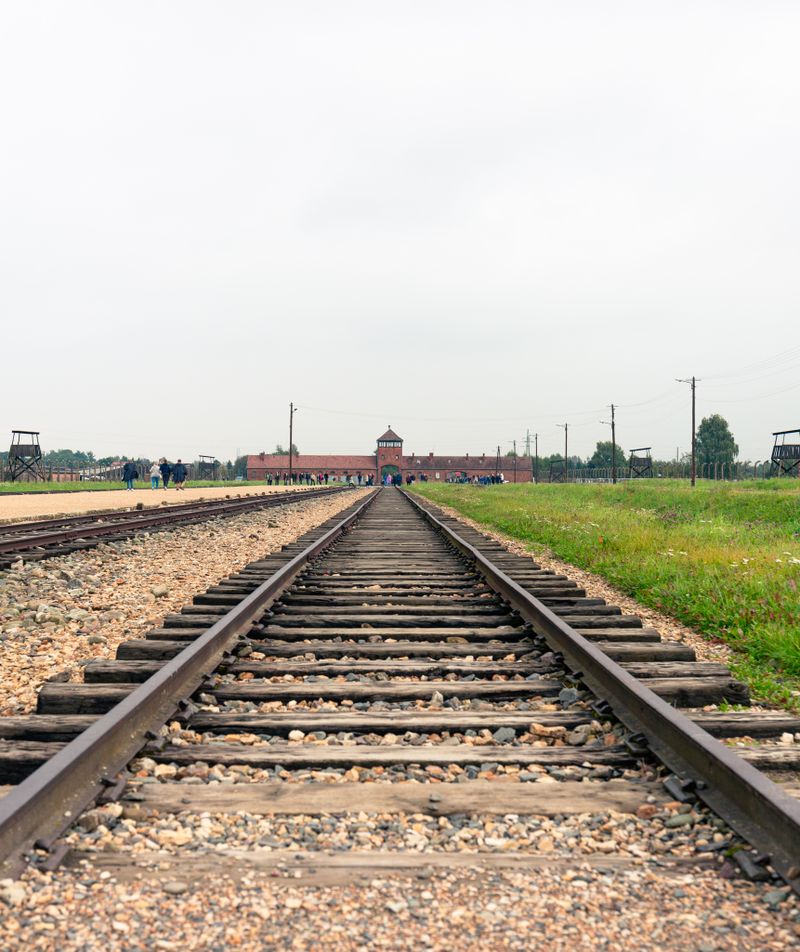
The visit itself: Auschwitz I holds the documentary exhibitions — the belongings, the corridors of photographs — and Birkenau, three kilometers away, holds the scale: the gate, the ramp, the ruins of the crematoria. Both are required to understand either. Dress for weather; Birkenau is open ground in all seasons.
The register: this is a memorial to over a million murdered people, most of them Jews. Photograph with restraint and where permitted, keep voices low, and give it the full day — combined tours pairing the Memorial with the salt mine exist and run long and emotionally compressed; the honest recommendation is to let this day be only this. Children under 14 are discouraged by the Museum itself. Pair the visit with Schindler’s Factory or the Galicia Jewish Museum in Krakow on another day, and with nothing cheerful on this one.
Read the full Auschwitz-Birkenau Memorial day-trip page.
Wieliczka — The Salt Cathedral
Thirty minutes southeast, the Wieliczka Salt Mine descends into seven centuries of excavation: 135 meters down, kilometers of tunnels, underground saline lakes, and chambers carved entirely from salt — culminating in the Chapel of St. Kinga, the ballroom-sized church where the chandeliers, the altarpiece, and the relief of the Last Supper are all salt, carved by miner-sculptors over decades.
The mechanics: entry runs by guided tour only, the standard tourist route takes two-plus hours, and the way in is 800-plus steps down (the way out is by lift — the mine’s clanking cage elevator is its own small event). The temperature holds around 15 degrees year-round, so bring the layer, and the route’s length rules out serious mobility limits. Prime midday slots sell out days ahead in season — book on the mine’s official site, and the early or late slots run quieter.
The tourist route shows a fraction of one percent of the mine, which is the fact that reframes everything; the miners’ route alternative hands you a lamp and a harder hat for the working-mine version; and the underground chambers host concerts and even a sanatorium, because the microclimate is genuinely therapeutic. Half a day, effortlessly paired with an afternoon in Kazimierz. It carries its UNESCO founding-list status without inflation.
Read the full Wieliczka Salt Mine day-trip page.
Zakopane & the Tatras — The Mountain Capital
Two hours south, Zakopane is Poland’s mountain resort — the wooden-villa capital of the Tatras, the country’s only alpine range — and the day sorts by ambition. The gentle version: the funicular up Gubałówka for the ridge-top panorama of the whole range, Krupówki street’s market economy (oscypek, the smoked sheep’s cheese, grilled with cranberry jam, is the mandatory street food), and the wooden churches and Witkiewicz villas that invented the Zakopane style.
The committed version: Morskie Oko, the Tatras’ great lake — a mirror of peaks reached by a paved nine-kilometer walk from the Palenica parking (two hours each way; horse-drawn carts shortcut most of it, chosen with a glance at the horses’ condition), with the higher lake Czarny Staw another steep hour up. Book the parking online in season or take the minibuses from Zakopane; summer weekends overwhelm both.
The cable-car version: Kasprowy Wierch lifts to 1,987 meters for the summit ridge, sold out days ahead in season. This is a long day — four hours of road wrap around whatever you choose — winter turns it into Poland’s ski capital with prices and crowds to match, and the mountain weather rules absolutely. Magnificent, and the day trip samples what calls for an overnight.
Read the full Zakopane day-trip page.
Ojców & Pieskowa Skała — The Miniature Park
Thirty minutes northwest, Ojców National Park is Poland’s smallest — a limestone ravine of white crags, caves, and beech forest that packs castles, rock formations, and chapels into a valley you can walk end to end in a morning.
The circuit: the ruined Ojców castle on its crag, Hercules’ Club — the freestanding limestone pillar that is the park’s signature — and Pieskowa Skała, the Renaissance castle above it, a genuine jewel with an arcaded courtyard and a branch of the Wawel collection inside. The Chapel on the Water, built over a stream because a tsar forbade building “on the ground” of the area and the locals took him literally, is the park’s best story standing. Łokietek’s Cave adds the guided underground hour where a future king reputedly hid from Bohemian soldiers.
This is the gentle, cheap, close day — trails are family-graded, the valley floor is flat, and the whole park plus castle runs five or six hours with lunch. Weekends draw Krakow’s own families, so weekdays walk quieter. It’s the exhale day, and the right pairing for the afternoon after an early Wieliczka slot — or the recovery day after Oświęcim, which is a sequencing many travelers quietly need.
The Dunajec Gorge — Rafting the Old Way
Two hours southeast, the Dunajec river gorge cuts limestone walls three hundred meters deep between Poland and Slovakia, and the way through it hasn’t changed in form since the 1830s: flat wooden rafts, lashed from five canoe-like sections, poled and steered by flisacy — raftsmen in embroidered vests and black hats whose families have run the gorge for generations, and whose commentary is half geology, half deadpan.
The mechanics: the classic run goes Sromowce Niżne to Szczawnica, about two and a quarter hours on the water through the Pieniny park’s bends, with Trzy Korony’s crown of peaks above. The season runs April through October, water levels permitting; no skill is required, the rafts are stable, and children ride happily. Book ahead in July–August or join the morning queue early.
The stack: the Trzy Korony summit hike (two-plus hours up from Sromowce for the gorge-from-above view), Niedzica Castle on its reservoir at the gorge’s entrance, and Szczawnica’s spa-town promenade at the takeout for the ice-cream finish. This is the family-and-scenery day — gentle water, big walls, genuine tradition — and the bike path back along the river turns it into a two-sport day for the energetic.
Wawel, Kazimierz & Krakow Itself
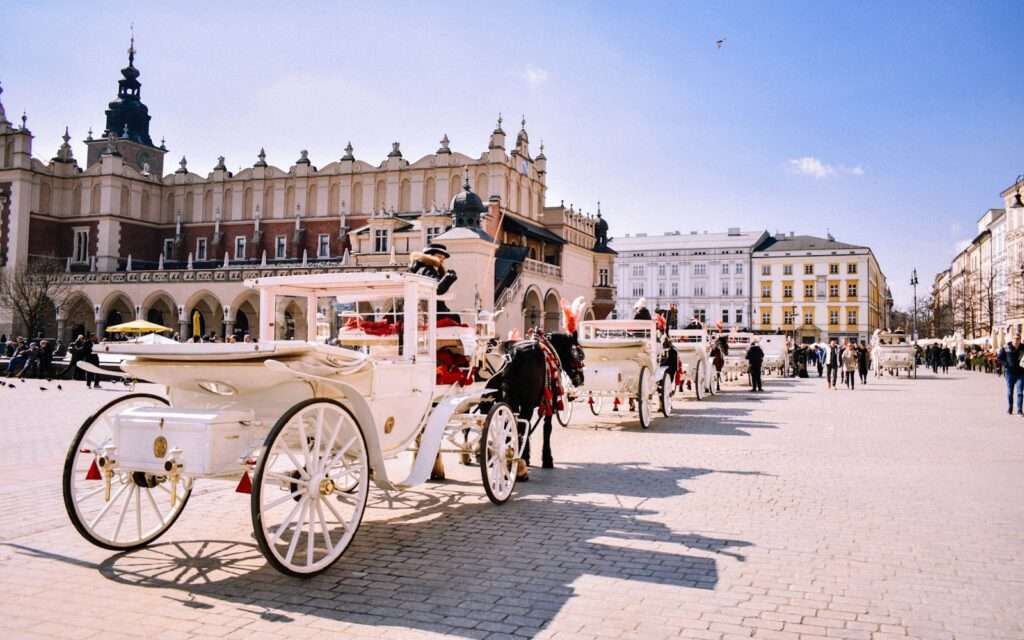
The city first: Wawel hill stacks the castle and cathedral where Polish kings were crowned and buried — the Sigismund Bell tower climb, the state rooms by timed ticket (book the headline exhibitions ahead; the courtyard is free), and the dragon’s den exit to the fire-breathing statue below. The Rynek — Europe’s largest medieval square — runs the Cloth Hall’s stalls, St. Mary’s carved Veit Stoss altarpiece (opened daily at 11:50), and the hejnał: the trumpet call sounded from the tower every hour, cut off mid-note in memory of the trumpeter legend, and the city’s most charming institution.
Kazimierz, the historic Jewish quarter, gets its register stated: seven synagogues survive, the Remuh cemetery’s wall of fragments carries the weight, and the quarter’s revival — cafés, galleries, the plac Nowy zapiekanka windows — lives alongside the memory rather than over it; the Galicia Jewish Museum and the Old Synagogue tell the history properly, and the JCC’s presence tells the present one. Across the river, Schindler’s Factory museum covers occupied Krakow with the thoroughness the films can’t, booked ahead.
The rest: obwarzanek from the street carts (the ring-shaped pretzel-bagel with its own protected status), pierogi and żurek in the milk-bar economy where lunch costs pocket change, and the Planty ring-park replacing the walls for the evening circuit. Season math: May–June and September are the windows; summer fills the Rynek terraces and the mountain roads; December’s Christmas market runs one of Europe’s most atmospheric; and the smog honesty applies to winter inversions — the mountain and gorge days above breathe easier than the city on the worst weeks.
Full day-trip pages: Częstochowa.
Frequently Asked Questions
How do you book Auschwitz-Birkenau?
Only at visit.auschwitz.org — since March 1, 2026, all entry passes are online-only with no on-site sales. Entry is free with a reserved pass; the 3.5-hour educator-guided tour is the recommended first visit. Names must match photo ID, and season slots go weeks ahead.
Should you combine Auschwitz with the salt mine in one day?
Combined tours exist, and the answer is no — the Memorial needs its own day, unhurried and paired with nothing cheerful. Wieliczka fits any other half day.
Do you need to book Wieliczka in advance?
In season, yes — guided entry only, and prime midday slots sell out days ahead on the official site. Expect 800-plus steps down (lift up), two-plus hours, and a steady 15 degrees; bring a layer.
Is Morskie Oko worth the effort from Krakow?
Yes, as a long day — two hours’ drive plus a two-hour paved walk each way to the Tatras’ great lake. Book the Palenica parking online in season or ride the Zakopane minibuses, and start early; summer weekends overwhelm it.
What is the Dunajec raft trip like?
Two-plus gentle hours on flat wooden rafts steered by traditional flisacy through a 300-meter limestone gorge — stable, family-friendly, April through October. Book ahead in high summer; Trzy Korony’s hike adds the view from above.